
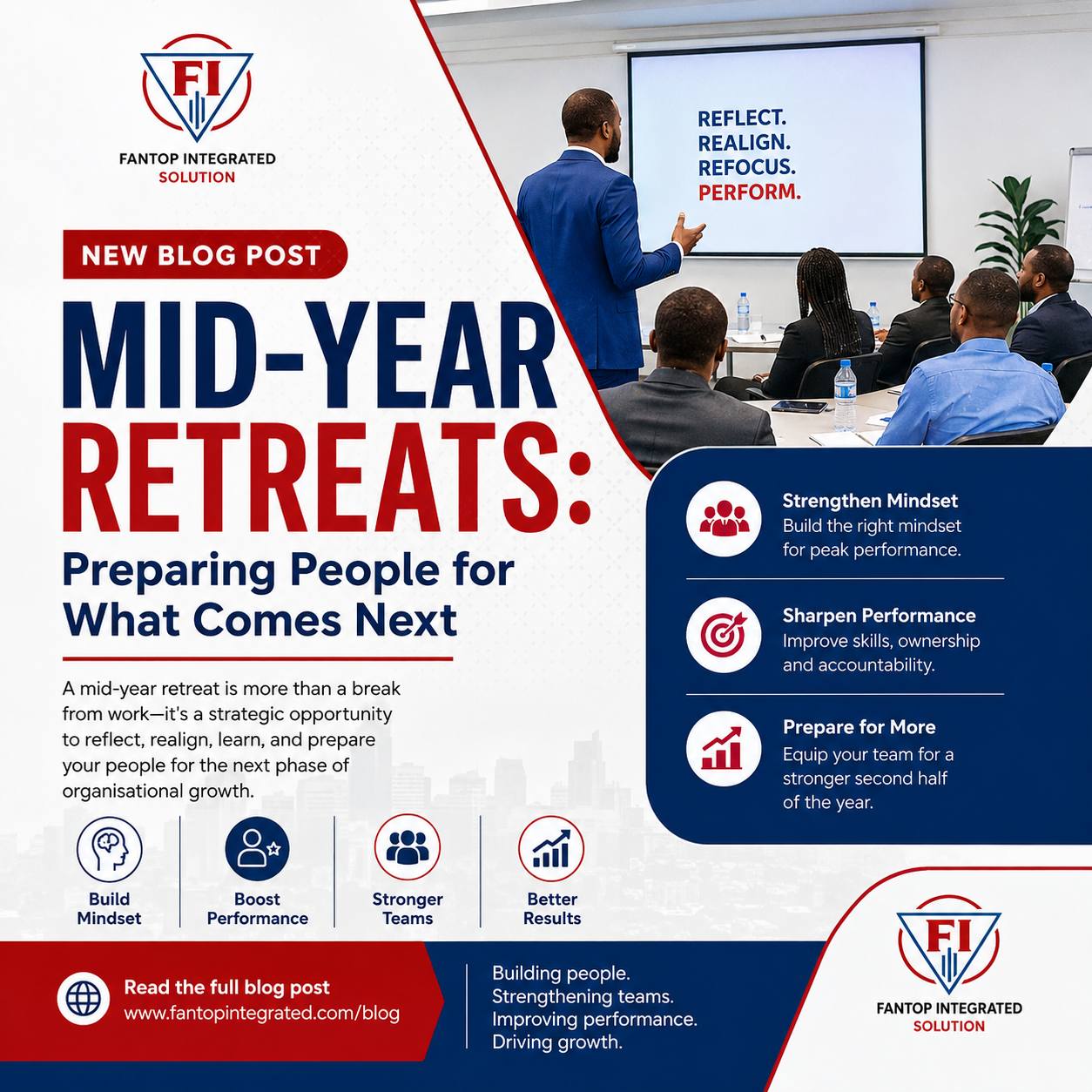
A mid-year retreat should be more than a temporary break from the workplace. When properly designed, it becomes an opportunity for an organisation to pause, reflect, realign its people, and prepare for the demands of the months ahead.
The middle of the year provides a natural opportunity for organisations to evaluate their progress and ask important questions:
- Are our people still aligned with our organisational goals?
- Are we performing at the level required?
- What is working, and what needs to improve?
- What do our employees need to perform better in the second half of the year?
- Are our teams prepared for the next stage of organisational growth?
Recently, I had the privilege of facilitating a mid-year retreat for the Green Group of Companies, where I trained the team on Apex Premium and the Heart of Performance.
The retreat was not simply about delivering training. It was about helping the team strengthen their mindset, improve their approach to performance, take greater ownership of their responsibilities, and become better prepared for the next phase of the Group’s growth.
Why Mid-Year Retreats Matter
The first half of the year often provides valuable information about the health and direction of an organisation.
Some teams may have exceeded their targets. Others may be struggling to meet expectations. Some employees may require additional motivation, while others may need clearer direction, stronger leadership, better communication, or improved skills.
A mid-year retreat creates space to examine these realities away from the pressure of everyday operations.
It allows leaders and employees to step back and consider not only what the organisation has achieved, but also how those results were achieved and what needs to change moving forward.
This is important because organisational performance is closely connected to the people responsible for delivering it.
When employees understand their responsibilities, take ownership of their work, communicate effectively, and remain committed to continuous improvement, the organisation is better positioned to achieve sustainable results.
The Connection Between Mindset and Performance
One of the important lessons from the retreat was the relationship between mindset and performance.
An employee’s performance is not determined solely by their job description or technical skills. Attitude, discipline, accountability, ownership, initiative, and willingness to learn can significantly influence the quality of their work.
Two employees may have similar qualifications and perform similar roles, yet produce very different results because of differences in mindset and approach.
This is why employee development should go beyond teaching technical skills.
Effective training should also challenge employees to think differently, understand the impact of their decisions, take responsibility for their roles, collaborate with others, and recognise how their individual contributions affect the wider organisation.
When people improve, teams can improve. When teams improve, organisations have a stronger foundation for growth.
Preparing Employees for the Second Half of the Year
The second half of the year should not simply be a repetition of the first.
It should provide an opportunity to improve processes, correct weaknesses, strengthen teams, and pursue better results.
For the Green Group of Companies, the retreat provided an opportunity to prepare the team for the next phase of the organisation’s development.
That preparation requires more than setting new targets.
Employees must also be prepared mentally, professionally, and strategically to achieve those targets.
This raises an important question for every organisation:
What do our people need to become before we can expect better results from them?
The answer may involve stronger leadership, improved communication, better work habits, increased accountability, professional development, coaching, or a change in organisational culture.
Understanding these needs can help organisations make better decisions about employee training and development.
Training Should Produce More Than Knowledge
One of the common mistakes organisations make when organising training is measuring success by attendance rather than impact.
Employees can attend a training programme, take notes, participate in activities, and leave with new information. But the real question is:
What changes after the training?
Effective training should influence behaviour.
It should help employees become more intentional about how they work, communicate, lead, solve problems, serve customers, and contribute to organisational goals.
For this reason, training should be connected to the actual challenges and objectives of the organisation.
A strong training programme should help employees move from:
Knowledge → Understanding → Application → Behaviour → Performance
That progression is what turns training from an event into an investment.
Building People for Better Performance
At Fantop Integrated Solutions Ltd, we believe that stronger organisations are built by developing stronger people.
Our services include training, coaching, and human resource solutions designed to help organisations identify performance gaps, strengthen their teams, develop their people, and prepare employees for the demands of organisational growth.
Every organisation has different challenges.
Some may need to improve employee discipline and accountability. Others may need stronger leadership, better customer service, improved teamwork, or a renewed performance culture.
The right intervention begins with understanding the organisation’s people, goals, challenges, and future direction.
What Should Happen After a Mid-Year Retreat?
The retreat should not end when employees leave the venue.
The most important part begins afterwards.
Leaders should follow up on the lessons from the retreat and translate them into practical actions.
This may include setting clearer performance expectations, reviewing individual responsibilities, establishing follow-up coaching sessions, monitoring behavioural changes, improving communication, and recognising employees who demonstrate positive changes.
Without follow-up, even a well-delivered retreat can quickly become another event that employees remember but fail to apply.
The real measure of a successful retreat is what happens when employees return to their normal responsibilities.
Do they work differently?
Do they communicate better?
Do they take greater ownership?
Do they demonstrate stronger discipline?
Do they serve customers better?
Do they contribute more effectively to team objectives?
These are the outcomes that matter.
Preparing People for What Comes Next
Every organisation is moving toward something.
It may be expansion, improved profitability, increased customer satisfaction, stronger operational efficiency, new markets, or a new level of professional excellence.
Whatever the goal may be, organisations need people who are prepared to support that direction.
A mid-year retreat provides an opportunity to stop, assess the present, and prepare for the future.
For organisations serious about sustainable growth, investing in people should not be viewed as an occasional activity. It should be part of the organisation’s broader strategy.
At Fantop Integrated Solutions Ltd, we are committed to helping organisations build capable people, stronger teams, and better performance through practical training, coaching, and human resource solutions.
The next phase of your organisation will require prepared people.
Is your team ready?
Let’s have that conversation.
Leave a Reply