

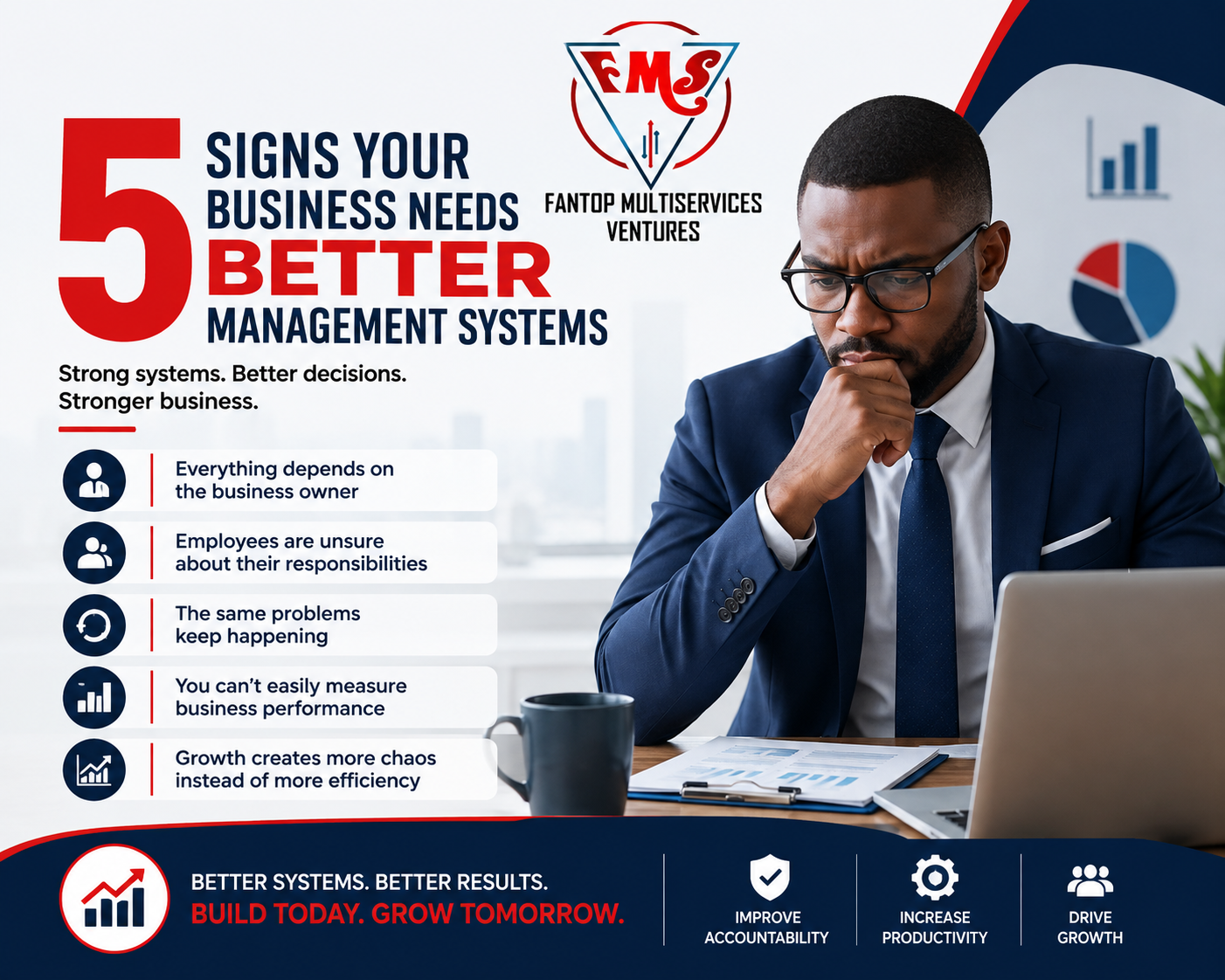
5 Signs Your Business Needs Better Management Systems
A business can have talented employees, quality products, and a strong market opportunity and still struggle to grow. One of the most common reasons is the absence of effective management systems.
Management systems provide the structure businesses need to organise people, processes, information, resources, and performance. They help employees understand their responsibilities, enable managers to monitor operations, and make it easier for business owners to make informed decisions.
Without proper systems, businesses often depend too heavily on individual employees, verbal instructions, constant supervision, and the personal involvement of the business owner. This may work when the company is small, but it becomes increasingly difficult as the business grows.
If your business is experiencing operational challenges, the following five signs may indicate that it is time to improve your management systems.
1. Everything Depends on the Business Owner
One of the clearest signs that a business needs better management systems is excessive dependence on the owner.
If employees constantly need the owner’s approval before making routine decisions, customers always have to speak directly with the owner, or important tasks stop whenever the owner is unavailable, the business may lack proper operational systems.
A well-managed business should not depend entirely on one person to function effectively.
Clear procedures, defined responsibilities, approval structures, reporting systems, and performance standards allow employees to handle their responsibilities with greater confidence.
How to improve this
Start documenting important business processes. Create clear guidelines for areas such as:
- Customer service
- Sales
- Procurement
- Finance
- Employee responsibilities
- Complaint handling
- Reporting
- Quality control
- Daily operations
The goal is to make the business less dependent on memory and individual personalities.
2. Employees Are Unsure About Their Responsibilities
Another major warning sign is confusion about who is responsible for what.
When employees frequently ask questions such as “Who should handle this?”, “Am I responsible for this?”, or “Who should approve this?”, there may be a problem with the company’s organisational structure.
Unclear responsibilities can lead to duplicated work, neglected tasks, internal conflicts, delays, and poor accountability.
Effective management systems establish clear roles and responsibilities. Employees should understand what they are expected to do, who they report to, what decisions they can make, and how their performance will be evaluated.
How to improve this
Develop clear job descriptions and responsibility structures for every position.
For each role, define:
- Key responsibilities
- Expected results
- Reporting line
- Decision-making authority
- Performance indicators
- Required skills
- Daily, weekly, and monthly tasks
When employees understand their responsibilities, accountability becomes easier to establish.
3. The Same Problems Keep Happening
Does your business repeatedly experience the same problems?
Perhaps customers regularly complain about delayed responses. Maybe invoices are frequently sent late, stock records are inaccurate, employees miss deadlines, or important information keeps getting lost.
Recurring problems are often symptoms of weak systems.
Solving a problem once is different from creating a system that prevents the problem from happening repeatedly.
For example, if customer complaints are handled differently by every employee, the business may continue to experience inconsistent service. A standard customer complaint procedure can establish exactly how complaints should be received, documented, escalated, resolved, and followed up.
How to improve this
When a problem occurs repeatedly, don’t only ask, “Who made the mistake?”
Ask:
“What system allowed this mistake to happen repeatedly?”
Then create a process that addresses the root cause.
This could involve:
- Standard operating procedures
- Checklists
- Approval processes
- Staff training
- Digital record keeping
- Quality-control procedures
- Regular performance reviews
A strong management system should reduce the frequency of preventable problems.
4. You Cannot Easily Measure Business Performance
You cannot effectively manage what you do not measure.
If your business does not have clear performance indicators, you may find it difficult to determine whether the company is improving, stagnating, or losing money.
Many business owners focus on revenue while overlooking other important indicators such as customer retention, employee productivity, operating costs, sales conversion rates, inventory turnover, and service quality.
Better management systems provide reliable information that supports decision-making.
How to improve this
Identify key performance indicators that are relevant to each department.
For example:
Sales:
Track leads, conversion rates, sales revenue, average transaction value, and customer retention.
Customer service:
Track response time, complaints, resolution time, customer satisfaction, and repeat customers.
Finance:
Monitor revenue, expenses, cash flow, receivables, payables, and profitability.
Operations:
Measure productivity, turnaround time, errors, wastage, and service delivery.
Performance data gives management a clearer picture of what is actually happening inside the business.
5. Business Growth Creates More Chaos Instead of More Efficiency
Growth is usually considered a positive development, but rapid growth can expose weaknesses in a company’s management systems.
When a business gains more customers, hires more employees, introduces additional products, or expands into new locations, informal processes may no longer be sufficient.
You may notice:
- More communication problems
- Delayed decisions
- Increasing customer complaints
- Difficulty supervising employees
- Poor financial control
- Inconsistent service delivery
- More operational mistakes
- Managers becoming overwhelmed
If adding more customers or employees creates disproportionate operational problems, your business may need stronger systems before pursuing further expansion.
How to improve this
Build systems that can handle growth.
This includes establishing:
- Organisational structures
- Standard operating procedures
- Management reporting
- Staff onboarding processes
- Performance management systems
- Customer management systems
- Financial controls
- Communication channels
- Technology and automation
The objective is to ensure that business capacity grows alongside business demand.
Why Better Management Systems Matter
Better management systems do more than organise employees. They create a framework for consistent business performance.
Improved Accountability
Employees know what is expected of them and can be evaluated against clearly defined responsibilities.
Greater Productivity
Clear processes reduce unnecessary delays, confusion, duplicated work, and repeated mistakes.
Better Customer Experience
When employees follow consistent procedures, customers are more likely to receive reliable and professional service.
Easier Decision-Making
Accurate records and performance data give management the information needed to make better decisions.
Reduced Dependence on Individuals
Documented processes allow the organisation to continue functioning even when specific employees are unavailable.
Sustainable Growth
Strong systems make it easier to manage increasing customers, employees, transactions, and operational responsibilities.
How to Build Better Management Systems
Improving management systems does not necessarily mean purchasing expensive software or creating complicated procedures.
Start with the fundamentals.
1. Map Your Business Processes
Identify the major activities that take place within your business and document how each one is performed.
2. Define Roles Clearly
Ensure every employee understands their responsibilities, authority, reporting structure, and performance expectations.
3. Document Standard Procedures
Create simple standard operating procedures for important and frequently repeated activities.
4. Establish Performance Indicators
Determine the measurements that will show whether each department and employee is achieving expected results.
5. Improve Communication
Establish clear channels for internal communication, reporting, escalation, and feedback.
6. Use Technology Where It Adds Value
Business management software, accounting tools, customer relationship management systems, project management platforms, and digital reporting tools can reduce manual work and improve visibility.
7. Review Your Systems Regularly
A management system should evolve as the business changes. Review your processes periodically to identify inefficiencies and opportunities for improvement.
Management Systems Should Support People, Not Complicate Their Work
A common mistake is creating systems that are unnecessarily complicated.
A good management system should make work clearer and more efficient. Employees should be able to understand the process, follow it correctly, and know when an issue needs to be escalated.
Keep procedures practical. Remove unnecessary steps and update processes when they no longer serve the business.
The best systems create clarity, consistency, accountability, and efficiency.
A business does not become professionally managed simply because it has more employees or generates more revenue. Professional management requires systems that enable people to work effectively and consistently.
If everything depends on the owner, employees are unclear about their responsibilities, the same problems keep recurring, performance is difficult to measure, or growth is creating operational chaos, it may be time to strengthen your management systems.
The earlier a business establishes effective systems, the easier it becomes to improve productivity, maintain service quality, hold employees accountable, and prepare for sustainable growth.
A growing business needs more than hard work. It needs systems that make good work repeatable.
Leave a Reply